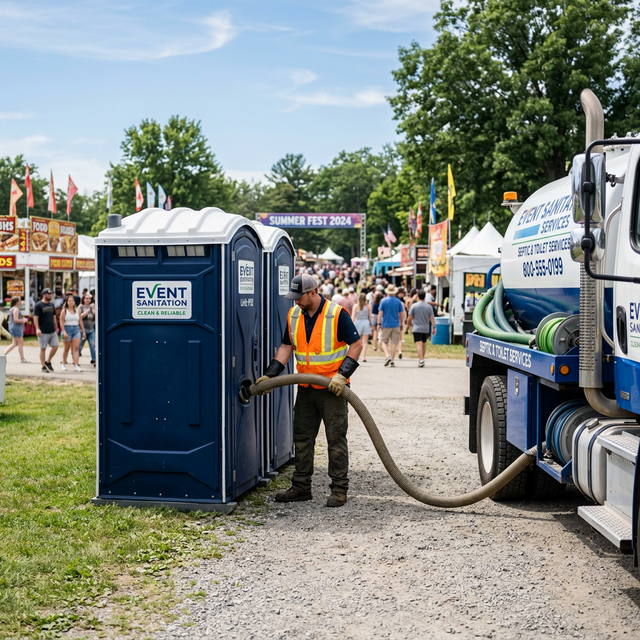
Guessing the number of portable restrooms required for an event leads to catastrophic sanitation failures or massive budget overruns. Event planners constantly under-order, resulting in overflowing units, horrific odors, and furious attendees. DispatchNode provides an AI-powered calculator that instantly determines the exact unit counts and service frequencies required to maintain pristine conditions for any crowd size.
The Science of Crowd Sanitation
Determining the correct number of portable toilets requires analyzing attendance duration, alcohol consumption, and demographic ratios. The DispatchNode AI calculator processes these variables instantly to generate a mathematically precise deployment plan. For a four-hour event with one thousand attendees serving alcohol, the baseline requirement is exactly twelve standard units and one ADA-compliant unit.
The mathematics of crowd sanitation are unforgiving. A standard portable restroom has a waste tank capacity of roughly sixty to seventy gallons, translating to approximately two hundred uses before reaching critical mass. If an event planner orders five units for a massive all-day festival, those units will overflow within the first few hours, creating a biohazard situation and destroying the event's reputation.
Our advanced software eliminates this guesswork. By inputting the expected attendance, the duration of the event in hours, and whether alcohol will be served, the system instantly outputs the required inventory. Alcohol is a massive variable; events serving beer or liquor experience a thirty to forty percent increase in restroom utilization rates, which the algorithm automatically factors into the final calculation.
Furthermore, the system accounts for demographic splits. Events with a higher ratio of female attendees require significantly higher unit counts to prevent massive queue formations. By providing event organizers with hard, algorithmically generated data, sanitation providers shift the liability of under-ordering back to the client, protecting their own reputation from the inevitable fallout of insufficient facilities.
Factoring in ADA Accessibility
Federal law mandates strict ratios for accessible sanitation facilities at public gatherings. The DispatchNode platform automatically calculates ADA unit requirements, ensuring that every deployment includes the legally mandated five percent minimum of fully accessible, wheelchair-friendly restrooms, protecting event organizers from severe federal discrimination lawsuits.
Accessibility is not a secondary concern; it is a strict legal requirement. The Americans with Disabilities Act dictates that for every cluster of portable restrooms at a public event, at least one must be ADA-compliant. The software automatically groups the required standard units into logical clusters based on the event footprint, ensuring that an accessible unit is deployed alongside every bank of standard toilets.
These accessible units require a significantly larger footprint and specialized placement to ensure clear, flat access routes. The dispatch system flags these specific units during the routing phase, ensuring that drivers allocate sufficient time and space during the drop-off process. The mobile app requires the driver to document the placement with a photograph, proving that clear access was established.
By automating the ADA calculation process, sanitation providers deliver massive value to their clients. Event planners are frequently unaware of the precise legal requirements regarding accessibility. When the AI system automatically includes the correct ratio of ADA units in the quote, it demonstrates deep industry expertise, building immense trust and securing the contract over competitors who fail to address compliance.
Determining Mid-Event Service Frequencies
For multi-day festivals or massive single-day events, simply dropping off units is insufficient; mid-event pumping is mandatory. The DispatchNode algorithm calculates precisely when units will reach capacity, generating automated work orders to dispatch vacuum trucks for mid-event servicing before overflowing occurs, ensuring continuous sanitation throughout the weekend.
Consider a three-day music festival with fifty thousand attendees. It is logistically impossible to deploy enough units to last the entire weekend without servicing. The software analyzes the exact capacity limits and generates a pumping schedule, routing trucks through the festival grounds during optimal windows, typically in the early morning hours before the crowds arrive.
This predictive servicing model prevents the nightmare scenario of an overflowing bank of toilets during peak attendance hours. The system tracks the exact location of every unit and provides the driver with a highly optimized route that minimizes driving time within the event footprint. The digital manifest records the exact time each unit was serviced, providing the event organizer with transparent proof of execution.
If an unexpected surge in attendance occurs, the event organizer can use the client portal to request emergency mid-event servicing. The AI voice agent or online portal instantly processes the request, locates the nearest available vacuum truck via GPS, and dispatches it to the specific zone requiring attention. This rapid response capability is a massive competitive advantage in the event sanitation industry.
Automating the Quoting and Booking Process
The traditional quoting process for large events requires endless phone calls, manual calculations, and delayed email proposals. DispatchNode automates the entire workflow, allowing event planners to input their event parameters online or via the AI voice agent, instantly receiving a mathematically accurate quote and the ability to secure the booking with a digital deposit.
When an event organizer calls the company, the AI receptionist asks all the necessary logistical questions: date, location, attendance, duration, and alcohol presence. It then runs the calculation engine in real-time, verbally quoting the exact number of units required and the total cost. The caller can then secure the inventory by paying a deposit via a secure Stripe SMS link sent directly to their phone.
This frictionless booking experience completely eliminates administrative overhead for the sanitation provider. There is no need for a dedicated sales team to manually calculate ratios or chase down signed contracts. The system generates a digital contract outlining the specific terms of service, which the client signs electronically on their smartphone.
By combining the precision of an AI calculator with the speed of automated booking and dispatching, portable sanitation companies can capture high-value event contracts effortlessly. The software ensures perfect legal compliance, eliminates the risk of under-ordering, and guarantees that the operator gets paid upfront, transforming the event rental process into a highly profitable, hands-off revenue stream.
Event-Specific Calculation Factors
Event portable toilet calculations differ significantly from construction site requirements. The variables that drive unit count recommendations for events are unique to the entertainment and hospitality industry.
A general outdoor event without alcohol requires approximately one unit per 100 guests for a 4-hour duration. Adding alcohol service increases the requirement to one unit per 50-75 guests due to increased urinary frequency. Multi-day camping festivals require one unit per 40 guests with twice-daily servicing. Corporate events with sit-down dining require one unit per 75 guests due to scheduled meal breaks that create concentrated usage spikes.
The International Association of Assembly Managers publishes event sanitation guidelines that many municipal permitting departments reference when issuing event permits. Submitting a unit count that aligns with these guidelines accelerates permit approval.
Event Planner Communication Checklist
When discussing portable toilet needs with event planners, gather these specific details to produce an accurate and profitable quote:
- Peak Concurrent Attendance: Not total ticket sales, but the maximum number of people on site at any one time. A music festival selling 10,000 tickets over a weekend may only have 4,000 on site concurrently.
- Bar Locations and Count: Each bar area requires a proportionally higher concentration of units within 200 feet to handle the alcohol-driven usage increase.
- VIP Section Size: VIP areas require separate, often luxury, units at a ratio of one per 25-35 guests to justify the premium ticket price.
- Accessibility Requirements: Local event permits typically mandate one ADA-compliant unit per 10-15 standard units deployed.
- Power Availability: Luxury trailers require electrical hookups. Confirm power access points with the venue before quoting trailer options.
For more on festival pricing, read our guide on Festival Event Portable Toilet Pricing.
Quick Reference Data
| Event Type | Ratio (Units:Guests) | Duration Factor | Alcohol Factor |
|---|---|---|---|
| Outdoor Wedding | 1:75 | +25% if over 4 hours | +30% if open bar |
| Music Festival | 1:50 | +50% if multi-day | +40% if beer garden |
| Corporate Event | 1:100 | Standard | +20% if cocktail hour |
| Sporting Event | 1:60 | +15% if over 3 hours | +35% if beer sold |
graph TD
    A["Input: Guest Count"] --> B["Apply Base Ratio"]
    B --> C["Adjust for Duration"]
    C --> D["Adjust for Alcohol"]
    D --> E["Add ADA Units"]
    E --> F["Final Unit Recommendation"]
Algorithmic Modeling of Event Fluid Dynamics
The standard method for calculating portable toilet requirements at events relies on static tables: an X-by-Y grid cross-referencing attendance duration with crowd size. While this provides a basic baseline, it fails catastrophically when applied to events with complex "fluid dynamics"—specifically, the consumption rates of food and alcohol relative to the ambient temperature and duration of the event. To prevent sanitation failures that destroy an event's reputation, operators must employ advanced computational models.
The primary variable in these advanced models is the "diuretic multiplier." At a standard, alcohol-free corporate event lasting four hours, the average attendee utilizes the facilities 1.2 times. However, at a beer festival of the same duration, the consumption of alcohol suppresses the production of vasopressin (the anti-diuretic hormone), increasing the utilization rate to 3.5 times per attendee. If an operator applies a standard static table to the beer festival, they will under-equip the event by a factor of nearly three, guaranteeing overflowing units within the first two hours.
Advanced calculators, such as those integrated into EasyPottyRental, process these variables algorithmically. When an event planner utilizes the AI booking agent or the online portal, they must specify the event type, the presence of alcohol, and the expected high temperature for the day. The algorithm applies specific weighting to each variable. A high temperature (above eighty-five degrees) increases water consumption, but simultaneously increases the rate of fluid loss through perspiration, requiring a complex fractional adjustment to the base utilization rate.
Furthermore, the algorithm must account for "surge pacing." A continuous-flow event, such as a county fair, experiences steady facility utilization throughout the day. Conversely, a concert or a sporting event experiences massive, concentrated surges during intermissions or halftime. The calculator must recommend a unit count high enough to clear the surge queue within a biologically acceptable timeframe (typically under ten minutes). If the queue clearance time exceeds this threshold, attendees will begin seeking unauthorized relief areas, creating massive liability and cleanup costs for the event organizer.
The Financial Calculus of Over-Specification
While under-equipping an event is a logistical disaster, significantly over-equipping an event represents a failure of financial fiduciary responsibility to the client. An event planner operating on a strict budget relies on the portable sanitation operator to provide the exact mathematical intersection of safety and cost-efficiency.
Operators who lack confidence in their calculation methods often default to arbitrary over-specification, simply adding twenty percent to their best guess "just to be safe." This approach inflates the client's costs unnecessarily and ties up the operator's inventory that could be deployed to other revenue-generating sites. It also increases the transportation costs and the environmental footprint of the deployment without providing a commensurate benefit to the attendees.
A sophisticated, AI-driven calculator serves as an instrument of financial precision. By applying rigorous mathematical modeling to the event variables, the operator can present a proposal that is demonstrably lean yet perfectly adequate. The proposal can explicitly show the math: "Based on a six-hour duration, three thousand attendees, and a 1.4 alcohol multiplier, you require exactly thirty-eight standard units and two ADA units to maintain a maximum queue time of four minutes."
This level of transparency and mathematical rigor transforms the sales conversation. The event planner stops viewing the portable toilet quote as an arbitrary number to be negotiated down, and starts viewing it as an engineered specification. Furthermore, by optimizing the exact unit count, the operator demonstrates respect for the client's budget, often securing the contract over competitors who provided sloppy, inflated guesses. This computational precision becomes a primary pillar of the operator's brand reputation in the highly competitive event production market.
The inclusion of vendor and staff requirements in event calculation is a frequently overlooked variable that causes significant logistical strain. An event planner may accurately calculate the need for fifty units based on the attendee headcount, but completely ignore the two hundred food service workers, security personnel, and production crew members who arrive hours before the gates open and stay long after the crowd departs. The AI-driven calculator specifically prompts the organizer to detail the staffing footprint and recommends deploying a segregated cluster of units designated strictly for staff use, often secured with combination locks. This prevents the staff from overwhelming the public facilities before the event even begins, and ensures that critical personnel are not wasting productive time standing in long lines with attendees. This level of comprehensive planning demonstrates the operator's deep expertise in event production logistics.
 Routing: Scaling Disaster & Event Sanitation](/_next/image?url=%2Fassets%2Fblog%2Fgenerated%2Femergency_routing_porta_potty_1774649858679.png&w=3840&q=75)
 Requirements for Construction Sites 2026](/_next/image?url=%2Fassets%2Fblog%2Fhealth-inspection-toilets.png&w=3840&q=75)
 Companies Automate Booking with AI](/_next/image?url=%2Fassets%2Fblog%2Fporta-potty-delivery.png&w=3840&q=75)